read about in this blog.


For a few years, our family has tended to a small slice of heaven in the foothills of Virginia's Blue Ridge Mountains. The rolling hills give the land beauty, and our animals and crops help contribute to its life. Garlic is our primary crop and will be a frequent topic of this blog.


Showing posts with label garlic. Show all posts

Tuesday, July 12, 2011

Financials of a start-up farm

Most businesses don’t make money in their first year. The initial investments in property, supplies, utilities, and other product materials can be significant.

Farming is no different. I’ve spoken with some farmers who have spent almost a decade trying to turn a profit. It’s even more difficult for many of the sustainable farmers who don’t benefit from government subsidies in the same way the conventional farmers of the Midwest do. One farmer in Bedford County, Virginia, admitted to me that he would not be able to do what he does now if the land wasn’t already in his family’s name. Trying to lump that kind of property cost onto him (in addition to the machinery and other things he pays for) would have buried his farm.

I understand this now better than ever. I’ve said in other posts that farming is not my primary source of income, so financial impacts don’t hit me as hard as they would full-time agrarians. While we have sold some of our garlic and other produce in seasons past, 2011 is the first year that we have truly looked at this as a business, along with the marketing, inspections, certifications, etc. that go along with an energized business (it’s part of the reason you’re now reading this blog).

Despite our business-minded focus, our revenue stream remains small. We expect less than $1,000 this year in income from our produce. That is, if we didn’t have to occur any up-front costs. But this is essentially a start-up business, so costs abound. I’ve tallied our anticipated numbers, and once we account for holding back a part of our stock to use in the next planting, we will get back in sales only 50 to 60 percent of the money we have put into farming this year.

That means hundreds of dollars that we will lose. The notion isn’t entirely unexpected. Farming is something that my wife and I love, and like any passion (whether it’s skiing, boating, bowling, hiking, automobiles, etc.), people have to spend money to pursue it. We do hope that as our investment costs go down, that gap between what we spend and what we make in revenue will close ever more tightly. Someday, our spreadsheets may even go into the black.

But as part-time farmers, making money isn’t our priority. Getting good food -- grown in the best ways -- to people is important. It goes back to the idea of being stewards of our land, of the environment, and of society. That mentality does pay for itself.

Tuesday, June 28, 2011

Keeping the garlic high and dry

Nearly eight months of working, weeding, and waiting has led up to the past couple of days, during which time we got the bulk of our garlic out of the ground. (A collective “woo-hoo!” would be appropriate now.) As I mentioned in my previous post, Cherry Lane Farm are a very small operation, growing only a couple hundred bulbs -- as opposed to the thousands or tens of thousands that full-time commercial farms produce.

Still, the work is considerable for just two people.

And anyone who has grown onion-like crops can attest to the fact that removal from the ground is just the beginning of the end. For garlic, the next two to three weeks will be critical as we dry the bulbs, toughening the skins with the intent of sealing in the cloves’ flavor and freshness. Drier skins also mean that the bulbs will store longer and are less likely to succumb to mold.

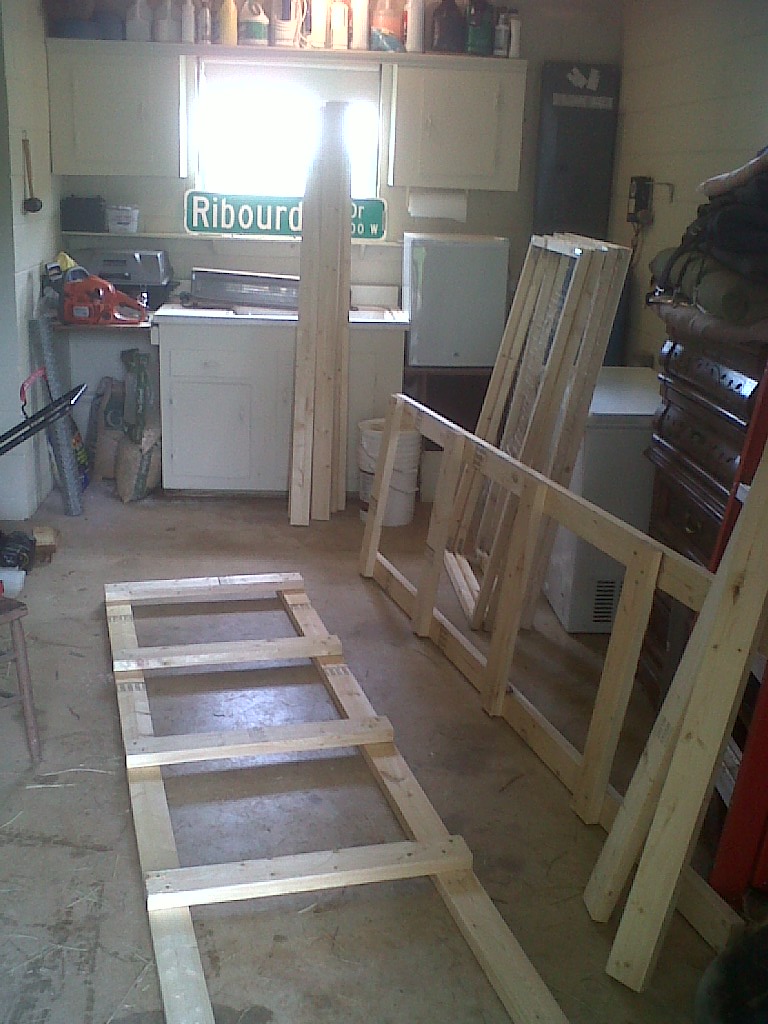
To accomplish this, I recently finished building my first drying rack, which uses an unusual construction compared with what I’ve done in the past. In prior years, I have simply grouped maybe 8-12 bulbs, tied them together, and hung them. This year, drawing from the ideas of the folks at Heartsong Farm in New Hampshire, the drying trays I built require the bulbs to be hung upside down, which you can see in the photos.


The rack allows for each bulb to be strategically placed to maximize airflow around it while maintaining efficiency of space. In a couple of weeks, I’ll be able to cut back the stalks (which will shrivel considerably) and trim the roots off. From there, the bulbs will be ready to be sold to friends and to a couple of restaurants in the Roanoke, Virginia, area.

We primarily sell three varieties:
Siberian: A milder-flavored Marbled Purple Stripe garlic. I used this two years ago in a batch of tzatiki, and it was the best tzatiki I’d ever made.
Inchelium Red: A medium-flavored Artichoke garlic. This is the first year we’ve grown this variety, but it has an award-winning history dating back to the early 1990s.
Persian Star: A medium-flavored Purple Stripe garlic, though I personally believe this is border-line strong-flavored. Expect a very distinctive taste and beautiful bulbs that have purple streaks on them.

Read more about any of these varieties at Gourmet Garlic Gardens.


Tuesday, June 21, 2011

Selling stewardship from the start

I am currently reading “Just Food” by James McWilliams, who argues about flaws in the locavore movement. The environmental underbelly of the process, he says, is that agricultural pollution isn’t primarily caused by the final transportation of the product but rather is compounded during the planting, harvesting, and processing of the crops. His early points suggest that larger, commercial farms are much more efficient than local (often, smaller) farms during many of the production stages and that their impact on the environment is considerably less than your farmer down the road.

There is a lot to be said for this approach to understanding the locavore movement, and I do take to heart some of the things that McWilliams is presenting. However, there are many questions to be asked, and I am still too early in the book to see whether I will receive answers to them. Here and now, the biggest question, as a small farmer myself, is: Why indict “the locavore movement” when some of us might be doing things right?

At Cherry Lane Farm, we have begun to harvest this year’s garlic. Over the past couple of years, we have planted more and more of our crop, meaning that the effort on both ends of the production process has become more time consuming and more difficult. What hasn’t changed with that expansion, though, is the structure of how we do things.

While I understand and accept that there is little chance sustainable farming will become the norm -- especially as global population growth fuels the need for commercial agriculture -- my wife and I at Cherry Lane Farm promote agriculture that has little-to-no impact on the environment and is healthful for the consumer. We are stewards of the land and of society. Machinery is kept to a minimum; muscle is maximized.

This week, as I began to dig up our garlic bulbs one-by-one with a shovel, I also thought back to when they were planted in October and November of last year. I took a spade and other hand tools and painstakingly dug the trenches. The only machinery used over the past eight months was a shallow hand tiller, which created trace amounts of erosion. Even looking a couple of weeks back, the garlic scapes were cut from the hardneck varieties with hand clippers -- patience being the most important part of the harvest.

Pulling the garlic from the ground, brushing the dirt away, and carefully setting it to dry is an intimate process. You become more in tune with what you’ve created and you don’t relinquish that connection to the cold metal of a machine.

Since I’m employed full-time elsewhere, my livelihood doesn’t depend on what I grow. The riches are spiritual instead of financial. And the method in which I harvest becomes impossible once a certain scale of production is reached. But as a grower and seller locally, I feed the locavore ideology. Environmentally, there are drawbacks to elements of the movement. But economically (and often nutritionally), the perks abound.

And when garlic or other produce is harvested with the simplicity of sweat and a spade, environmental stewardship becomes sound as well.